MBON11 [FBbt_00100246]


MBON11
ID: FBbt_00100246
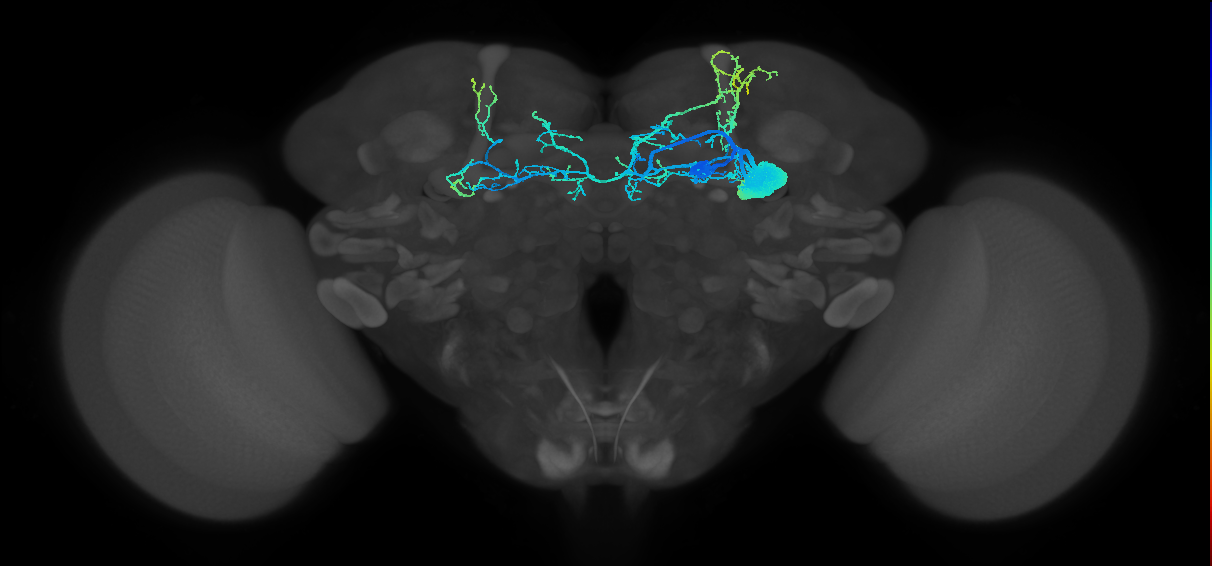
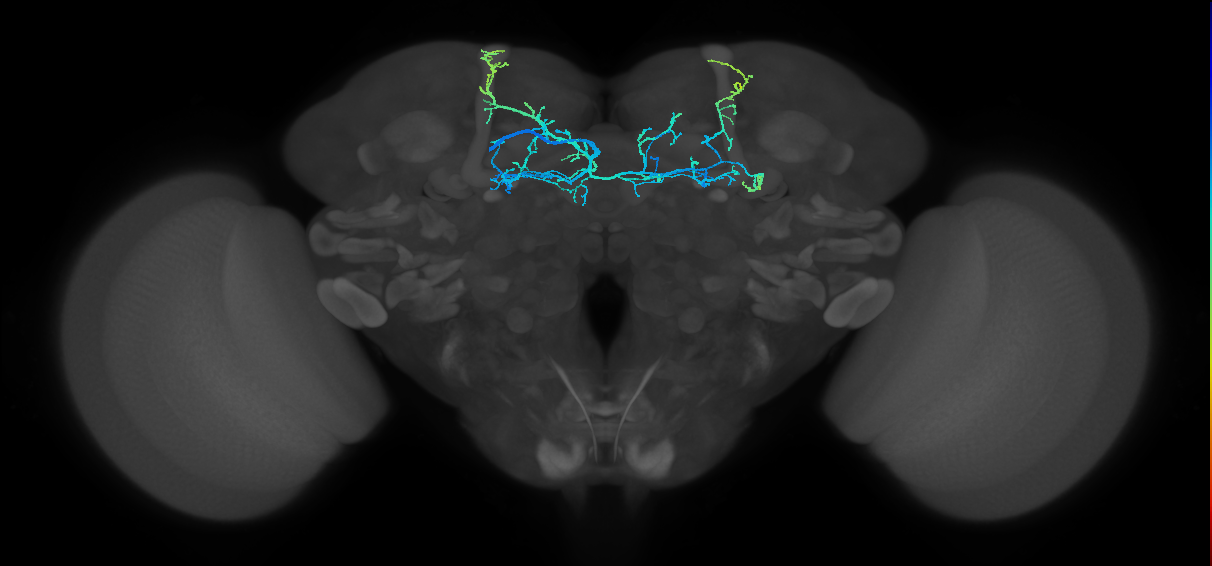
A GABAergic neuron whose cell body is located on the inferior neuropils (Tanaka et al., 2008; Aso et al., 2014). The cell body fiber runs posteriorly and bifurcates laterally and medially (Tanaka et al., 2008). The lateral branch arborizes in the lateral-most spur area of the gamma lobe (slice 1) and the core of the pedunculus (Tanaka et al., 2008), where it receives input from Kenyon cells (Aso et al., 2014). Its axon projects bilaterally to the alpha and beta lobes and contralaterally to the core of the pedunculus and, to a lesser extent, to the crepine. In the alpha lobe slice 3, its terminals are enriched in the surface layer. There is one neuron of this type in each hemisphere (Aso et al., 2014; Li et al., 2020). It receives input from the octopaminergic VPM3 and VPM4 neurons in the mushroom body gamma lobe slice 1 (Sayin et al., 2019). It synapses onto proximal parts of MBON01 and distal parts of MBON04 (Felsenberg et al., 2018). In the alpha lobe, it has feedforward connections onto MBON07 and MBON14 (Li et al., 2020). It is involved in food odor attraction (Sayin et al., 2019) and multiple stages of reward and punishment memory (Ichinose et al., 2021). It develops from the larval MBON-d1 (Truman et al., 2023).
Names are assigned according to the area of the mushroom body they arborize, as detailed in Tanaka et al. (2008).
Open in VFB 3D Browser →- adult GABAergic neuron
- adult typical mushroom body output neuron
- anterior ectoderm derivative
- primary interneuron
- supraesophageal ganglion neuron
Relationships
- bearer of: bilateral
- capable_of_part_of: associative learning, feeding behavior, memory, olfactory behavior
- develops from: larval mushroom body output neuron d1
- has soma location: cell body rind of adult inferior neuropils
- has synaptic IO in region: pedunculus of adult mushroom body
- is part of: adult brain
- receives synaptic input from neuron: octopaminergic VPM3 neuron, octopaminergic VPM4 neuron
- receives synaptic input in region: mushroom body gamma lobe slice 1
- sends synaptic output to cell: mushroom body output neuron 1, mushroom body output neuron 14, mushroom body output neuron 3, mushroom body output neuron 7
- sends synaptic output to region: adult crepine, adult mushroom body alpha-lobe, adult mushroom body beta-lobe
Alternative Names
| Synonym | Scope | Reference |
|---|---|---|
| MBON-11 | exact synonym | Aso et al., 2014 |
| MBON11 | exact synonym | Berg et al., 2025 |
| MBON11 | exact synonym | Bates et al., 2025 |
| MB-MVP2 | exact synonym | 10471 |
| MBON11 | exact synonym | Li et al., 2020 |
| MBON-gamma1pedc>alpha/beta | exact synonym | Aso et al., 2014 |
| MBON11 | exact synonym | Scheffer et al., 2020 |
| MBON11 | exact synonym | Schlegel et al., 2024 |
| mushroom body pedunculus-medial lobe and vertical lobe arborizing neuron 2 | exact synonym |
List all available images of MBON11 (14 total)
| Thumbnail | Name | Tags |
|---|---|---|
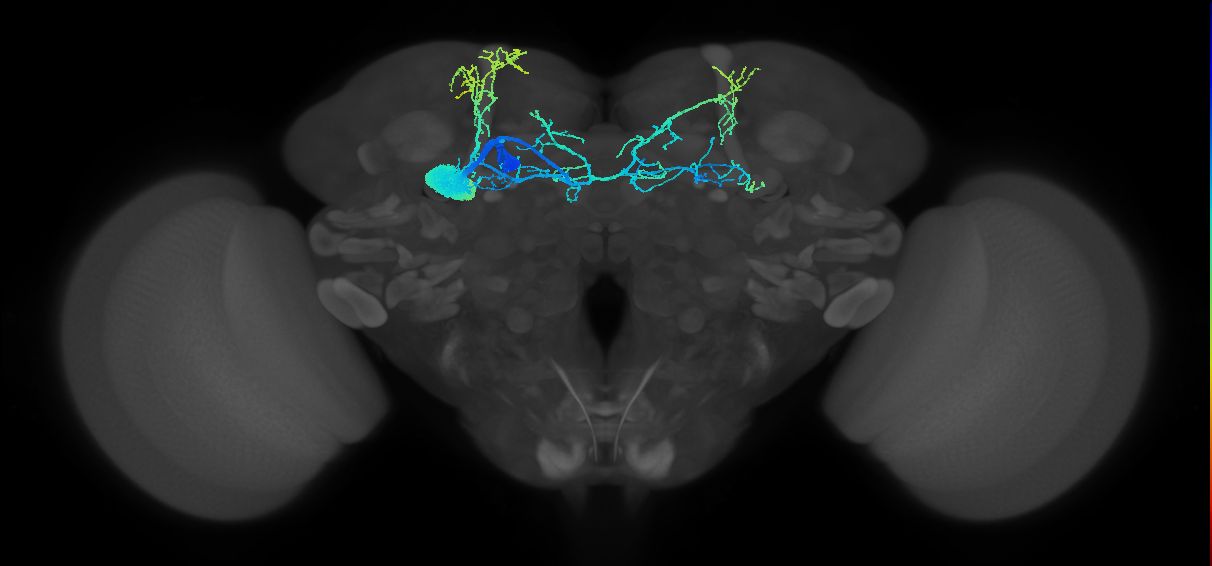 |
MBON11(y1pedc>a/B)_L (MaleCNS:10704) | Nervous_system, primary_neuron, GABAergic, Adult |
|
MBON11(y1pedc>a/B)_R (MaleCNS:11402) | Nervous_system, primary_neuron, Adult, GABAergic |
|
MBON11(y1pedc>a/B)_R | Nervous_system, primary_neuron, GABAergic, Adult |
|
MBON11(y1pedc>a/B)_R | Nervous_system, primary_neuron, GABAergic, Adult |
 |
MBON11(y1pedc>a/B)_R | Nervous_system, primary_neuron, GABAergic, Adult |
Expression patterns overlapping MBON11 (2 total)
| Thumbnail | Name | Tags |
|---|---|---|
| P{GMR12G04-lexA} expression pattern | Expression_pattern | |
| P{GMR83A12-GAL4} expression pattern | Expression_pattern |
Transgene expression in MBON11 (2 total)
| Thumbnail | Name | Tags |
|---|---|---|
| P{GMR12G04-lexA} expression pattern | Expression_pattern | |
| P{GMR83A12-GAL4} expression pattern | Expression_pattern |
Downstream connectivity classes for MBON11 (167 total)
| Thumbnail | Name | Tags |
|---|---|---|
Upstream connectivity classes for MBON11 (53 total)
| Thumbnail | Name | Tags |
|---|---|---|
Feedback
Was this page helpful?
Glad to hear it! Please tell us how we can improve.
Sorry to hear that. Please tell us how we can improve.