This is the multi-page printable view of this section.
Click here to print.
Return to the regular view of this page.
Compartmentalization of the mushroom body lobes
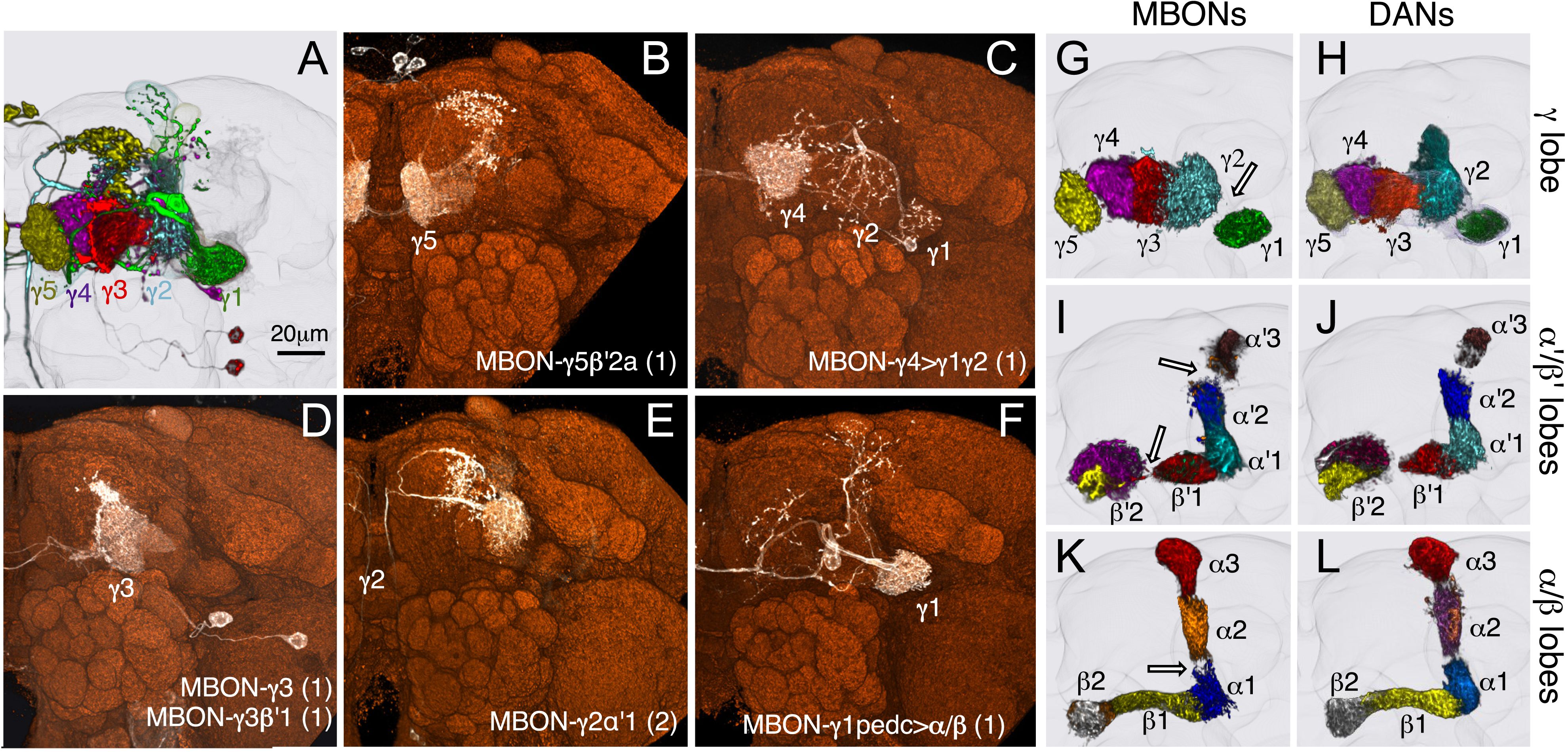
Compartmental organisation of the adult mushroom body lobes, showing how the dendrites of mushroom body output neurons (MBONs) and the axon terminals of dopaminergic neurons (DANs) tile the lobes into a stereotyped grid of 15 compartments. Adapted from Figure 10 of Aso et al. (2014a). Panels A–F show single examples of γ-lobe MBONs (MBON-γ5β′2a, MBON-γ4>γ1γ2, MBON-γ3, MBON-γ3β′1, MBON-γ2α′1, MBON-γ1pedc>α/β). Panels G/I/K give an MBON-side colour-coded map of the γ, α′/β′ and α/β lobes; panels H/J/L give the matching DAN-side map. Together these panels make explicit the compartments (γ1–γ5, β′1–β′2, β1–β2, α′1–α′3, α1–α3) used to organise input from PPL1 and PAM cluster DANs and output via MBONs. Click a labelled compartment to open the corresponding MB lobe slice in Virtual Fly Brain.
https://doi.org/10.7554/eLife.04577
Figure reproduced under CC-BY 4.0 from Aso Y, Hattori D, Yu Y, Johnston RM, Iyer NA, Ngo T-TB, Dionne H, Abbott LF, Axel R, Tanimoto H, Rubin GM (2014). The neuronal architecture of the mushroom body provides a logic for associative learning. eLife 3:e04577.